

Building Information Modelling (BIM) is a digital representation of physical and functional characteristics of a facility; a shared knowledge resource for information about a facility forming a reliable basis for decisions during its life-cycle” (NIMBS, 2013). Because of its various advantages, countries around the world including Malaysian are in race for its adoption in their Architectural, Engineering and Construction (AEC) industries. This course is designed to gear the students with BIM knowledge both the theory and architectural modelling skills. Therefore, in this course, students will be introduced to various BIM topics which includes concepts related to its application throughout the whole building life cycle in addition to the essential modelling and documentation skills of a BIM model. The objective of this course are as follows:
Objectives:
- To develop students’ theoretical and practical understanding towards the BIM process workflow and method within the whole life cycle of the project.
- To develop student’s technical skills in operating the BIM authoring tools within the architectural working practice.
- To develop student’s analytical skills in solving architectural design problems with BIM authoring tools as a platform.
My Student’s Works
Assignment 1 Sample: BIM Modelling & Documentation: Case Study
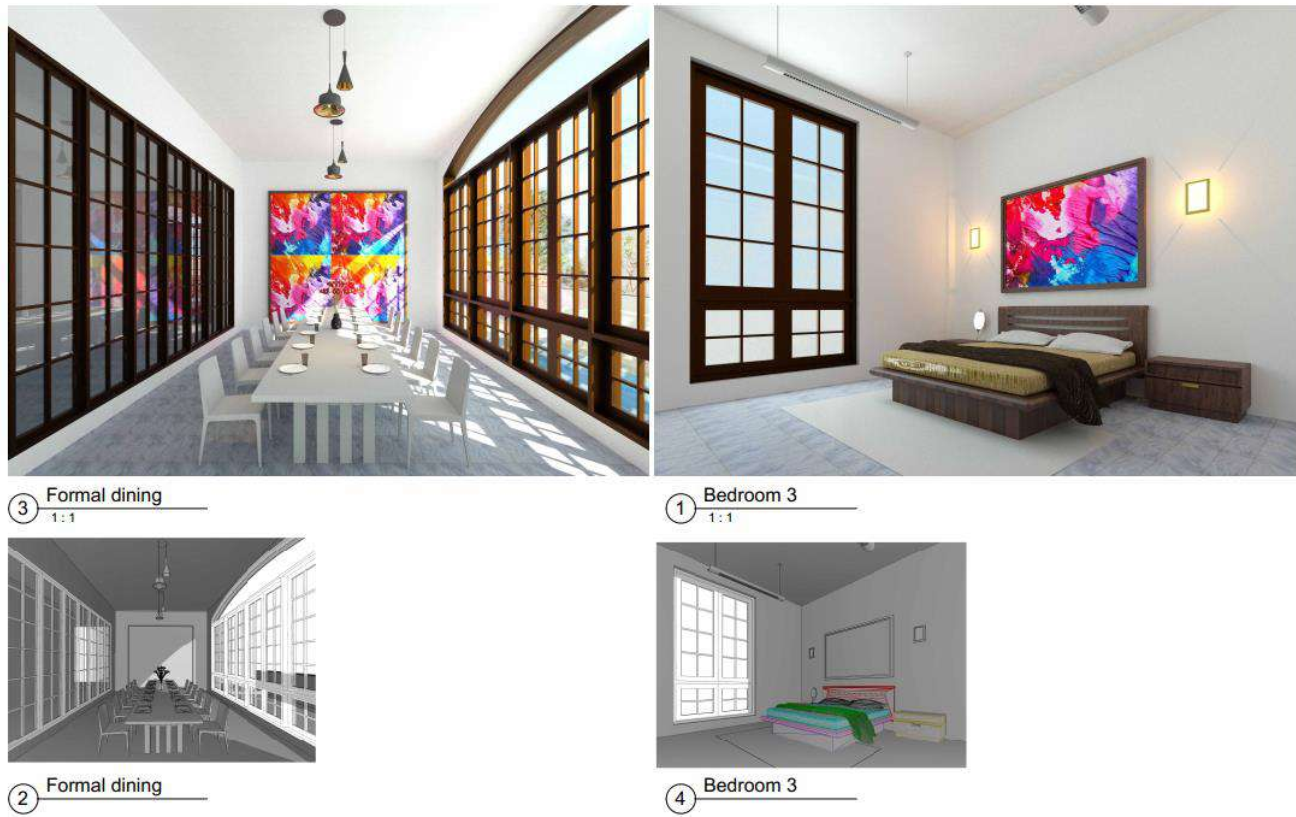
This assignment emphasizes BIM modeling and documentation. Each student chooses a case study consisting of two CAD drawings. They will then utilize Autodesk Revit to comprehensively model all components of the case study, leveraging BIM functionalities.
Assignment 2 Sample: BIM Beyond 3D Modelling
This assignment delves into the theoretical concepts associated with BIM. Each student is tasked with selecting a topic of interest related to BIM and conducting a literature search guided by questions provided in the assignment brief. Subsequently, students are required to compile their findings into a report and present them using slides.
Assignment 3 Sample: Computational BIM
Computational BIM is a problem-solving approach where users create algorithms to automate generating and manipulating building-related information. This helps improve work efficiency, effectiveness, and productivity. The goal of this assignment and lecture is to teach students the basics of computational BIM and data management using Dynamo for Revit, a top computational visual programming tool.
 TakiartVision